LinkedIn Pinpoint

Guess the category from five escalating clues.

2–5 minutesBy LinkedIn
linkedin.com/games/pinpoint
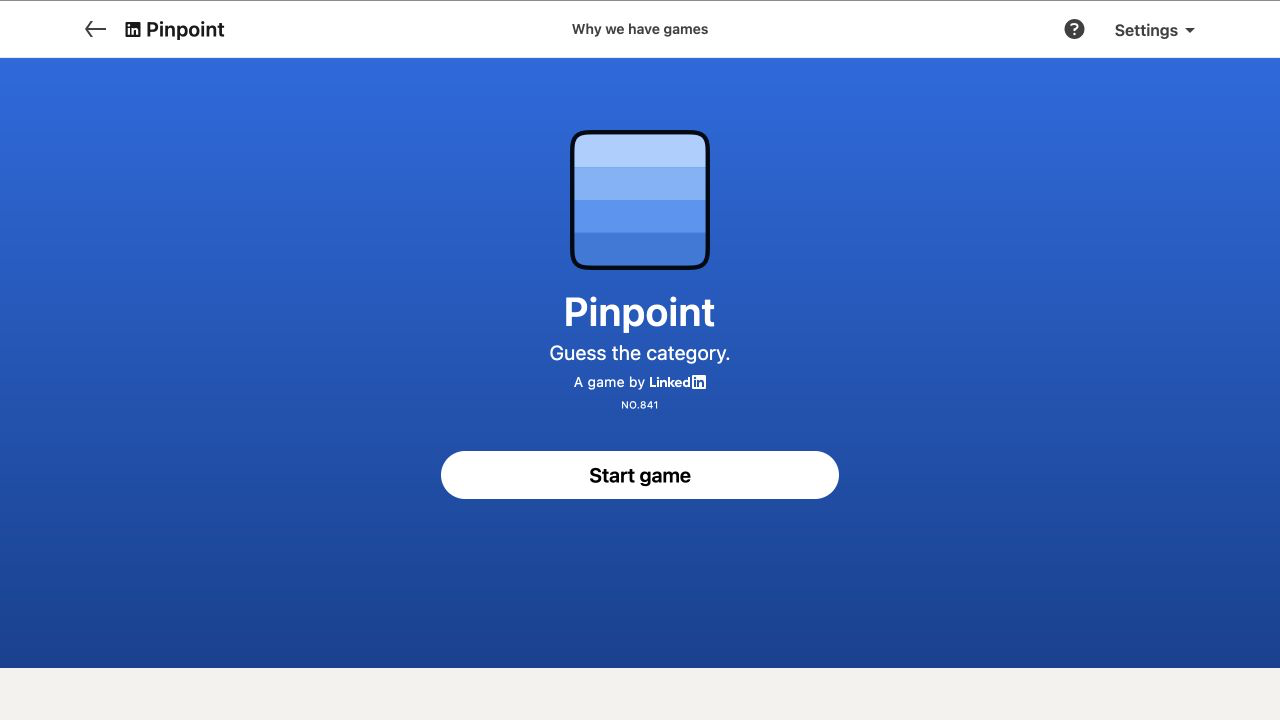
LinkedIn Pinpoint official start screen
Official LinkedIn Games start screen, captured August 2026.

What is Pinpoint?

Platform
Web
Access
Official LinkedIn link
Schedule
Daily at midnight PT
Session
2–5 minutes

Pinpoint is a daily word-association puzzle: five clues are revealed one at a time, and you guess the single category that ties them together — the fewer clues you need, the better. Use GameBut for clear rules and spoiler-free tips, then play the current puzzle on LinkedIn.

LinkedIn Pinpoint is a compact word-association game built around one deceptively difficult question: what exact label includes every clue on the board? Five clues are hidden at the start. You see the first, may submit a category, and reveal another clue when the evidence is not strong enough. An incorrect guess also exposes the next clue, so a speculative answer is not free. The best Pinpoint strategy is therefore a balance between speed and precision rather than a race to type the first connection that comes to mind.

A strong solve treats each clue as evidence with a different weight. The opening word is intentionally ambiguous and may support dozens of themes. The second clue should narrow the field, while later clues often define the grammar of the answer: brands, phrases beginning with a shared word, items found in one place, or members of a named group. This guide explains how to play LinkedIn Pinpoint, how scoring works, and how to improve while keeping the current daily Pinpoint answer completely unspoiled.

Core rules

  1. 1Reveal one clue at a time.
  2. 2Find the single category that connects every clue.
  3. 3Submit early for a better score, or reveal another clue when you are unsure.

Pinpoint strategy guide

Learn how category precision, clue order, and disciplined guessing improve a Pinpoint solve without revealing today’s answer.

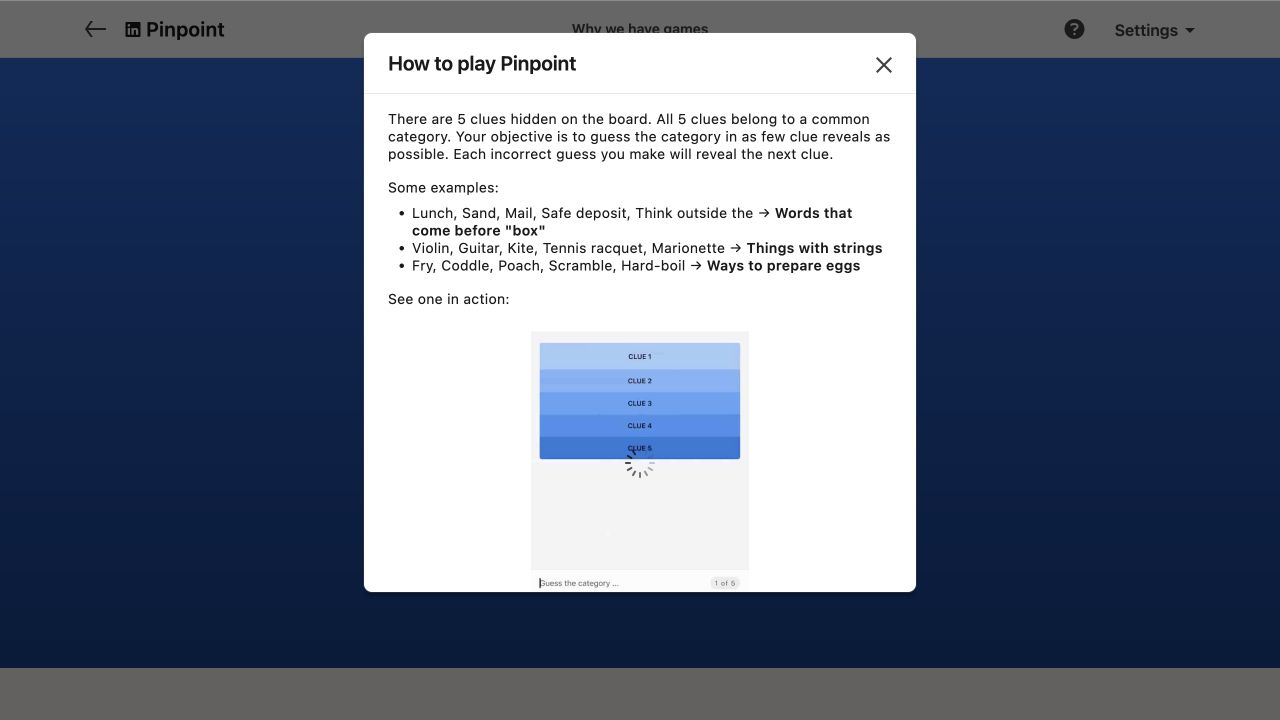
The official tutorial image shows the real game interface and an example puzzle, without revealing today's solution.

LinkedIn Pinpoint official tutorial showing the real game board
Official LinkedIn gameplay tutorial
1

Read the category, not just the topic

The most common Pinpoint mistake is finding a broad topic and treating it as the answer. If two clues are both connected to sport, for example, “sports” is usually too loose. Ask what sentence could introduce the finished list: “These are all ___,” “These words come before ___,” or “These can all be followed by ___.” A category that completes a clean sentence is more likely to match the puzzle editor’s intended wording.

Test the level of specificity before submitting. A valid category should include every visible clue directly and should not require a different explanation for each one. If one clue is a brand, another a place, and another an action, there may be a shared word or phrase rather than a literal group. Pinpoint rewards the exact relationship, so identifying the form of the relationship is often more useful than collecting more associations.
2

Use clue order as part of the puzzle

Clues are not equally revealing. The first is normally chosen because it can point in many directions; later clues are designed to separate plausible categories. After clue one, make a short mental list of possibilities instead of committing to a single theory. When clue two appears, look for the intersection between the two lists. This prevents anchoring, the habit of forcing every new clue into an early idea even when the fit becomes strained.

If the first two clues support several answers, revealing a third clue is often smarter than entering a low-confidence guess. Your score is based on how many reveals were needed, but an incorrect guess reveals another clue anyway. A deliberate reveal preserves attention and gives you time to compare the evidence. The goal is not always a one-clue win; it is the earliest defensible answer you can state precisely.

3

Build and challenge a working hypothesis

Once you have a candidate category, try to disprove it. Explain every visible clue in one short phrase, then search for an alternative that explains them more naturally. If your idea needs “kind of,” “sometimes,” or a long story, it is probably not narrow enough. This quick stress test is especially valuable when a clue has several meanings, such as a word that can be a name, object, verb, or place.

Pay attention to parts of speech and capitalization. A list of nouns may really be words that follow the same adjective; proper names may be products from one company; verbs may be ways to perform the same task. Pinpoint categories frequently depend on language structure, so reading the clues aloud and placing the same phrase before or after each word can expose a clean connection that silent free association misses.

4

Improve without memorizing answers

Review the explanation after a finished puzzle and classify the connection type. Keep a simple mental library: shared prefix, shared suffix, members of a set, things with a property, names within a franchise, or alternate meanings of one word. This trains recognition without using an answer archive. Over time, you begin to ask better questions earlier, which is the skill that actually lowers your average clue count.

Vocabulary helps, but flexible interpretation matters more. If a clue looks unfamiliar, do not stop the solve to chase it. Work from the clues you understand and infer what role the unknown item would need to play. Pinpoint is often solvable through elimination because the intended category must accommodate the entire set. A calm two- or three-clue solution is stronger practice than guessing repeatedly for a lucky one-clue result.

5

Understand the result you share

LinkedIn’s result card records the number of word reveals used, the path of the solve, and how closely the submitted wording matched the accepted category. That makes category phrasing part of performance. Synonyms may be understood, but a concise answer that names the shared relationship is safer than a sentence full of alternatives. If the connection is “words before box,” submit that structure rather than only “box things.”

The daily puzzle refreshes at midnight Pacific Time and the previous board expires. Your public post does not need to expose the clues or answer: the compact score grid is designed to invite comparison without spoilers. When discussing strategy with colleagues, talk about how many clues changed your theory or what connection type you recognized, not the specific words on the active board.

Common mistakes to avoid

These are rule misunderstandings and decision habits that create most avoidable errors.

Submitting a broad theme

A topic such as food, business, or music may connect the clues loosely but usually does not name the single editorial category.

Anchoring on clue one

The opening clue is deliberately flexible. Keep more than one hypothesis alive until another word provides real discrimination.

Ignoring wordplay

When the clues feel unrelated, test common prefixes, suffixes, compound phrases, titles, and alternate meanings before giving up.

Guessing to avoid a reveal

A wrong submission reveals the next clue too. If confidence is low, a controlled reveal is often the cleaner decision.

Pinpoint FAQ

Quick answers about rules, access, reset time, and score sharing.

How many clues are in LinkedIn Pinpoint?

Every daily Pinpoint puzzle contains five hidden clues. The objective is to identify the one category connecting all five while revealing as few clues as possible.

Does an incorrect Pinpoint guess hurt the score?

An incorrect guess causes the next clue to be revealed, so it effectively increases the reveal count. Guess when the wording is defensible, not simply because an idea is possible.

Do I need a LinkedIn account to play Pinpoint?

LinkedIn says members and non-members can play its games. Signing in adds network features such as streaks, comparisons, leaderboards, reminders, and optional score sharing.

When does the next Pinpoint puzzle appear?

LinkedIn releases a new puzzle at midnight Pacific Time. The previous daily puzzle expires, so use the official game link when you are ready to play that day’s board.

Does this guide reveal today’s Pinpoint answer?

No. GameBut focuses on stable rules, category-solving techniques, and spoiler-free Pinpoint tips. The current clues and answer are intentionally not reproduced on this landing page.

Try another puzzle

Ready to play Pinpoint?

Rules are checked against LinkedIn Help, and this guide never publishes today's clues, grid, path, or answer.

Spoiler-free by design