LinkedIn Wend

Connect letters to uncover every hidden word.

3–10 minutesBy LinkedInReleased 2026-06-09
linkedin.com/games/wend
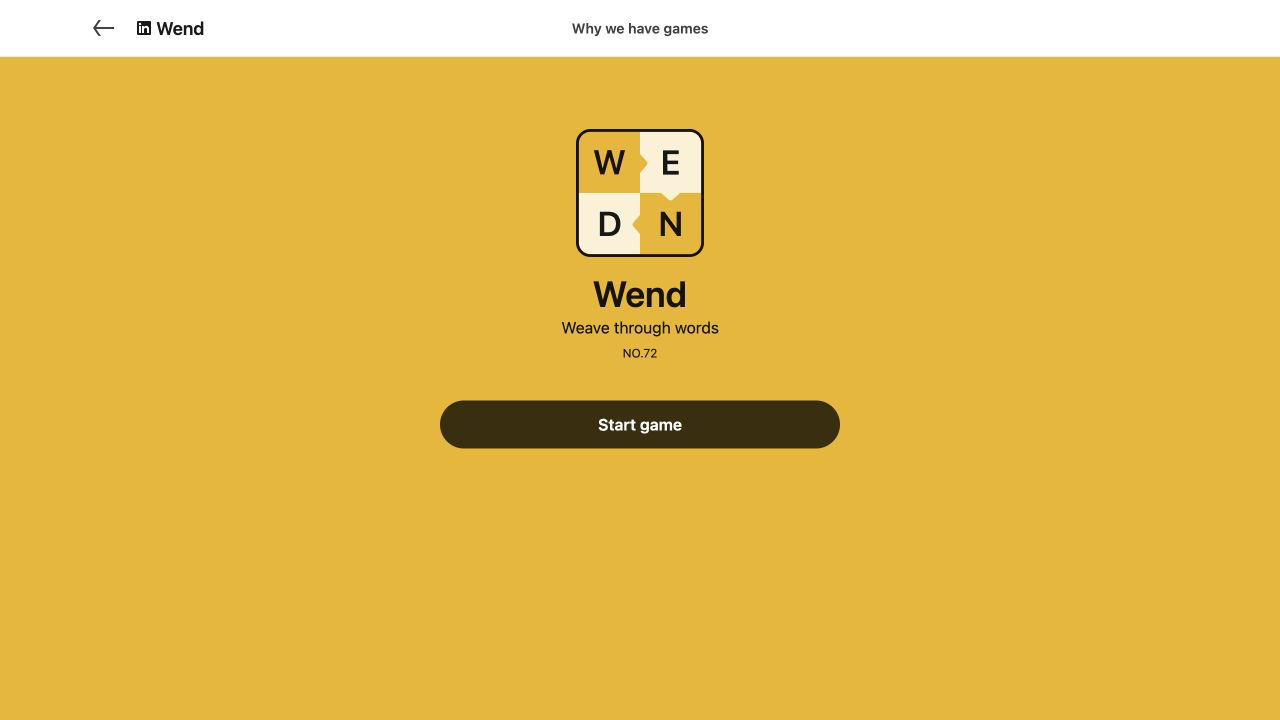
LinkedIn Wend official start screen
Official LinkedIn Games start screen, captured August 2026.

What is Wend?

Platform
Web
Access
Official LinkedIn link
Schedule
Daily at midnight PT
Session
3–10 minutes

Wend is a daily word-finding game from LinkedIn. Connect letters through the grid to find hidden words while using every letter exactly once.

LinkedIn Wend is a daily word-finding puzzle where letters connect horizontally or vertically—never diagonally—to form hidden words. Every grid letter must be used exactly once, and words cannot overlap. Empty rows beneath the grid show how many words are required and the length of each one. A dictionary-valid word is therefore only a candidate; it must also fit the supplied lengths and leave a viable path for every remaining letter.

Wend joined the lineup in June 2026 as LinkedIn’s eighth game and its first new word title since the original launch group. It blends vocabulary search with the route-planning pressure found in Zip. A strong Wend strategy pays special attention to corners, rare letters, word lengths, and leftover connectivity. This guide teaches those reusable techniques while keeping the current Wend words and board fully unspoiled.

Core rules

  1. 1Connect adjacent letters to form hidden words.
  2. 2Use every letter in the grid exactly once.
  3. 3Adjust earlier words when they block a valid path for the remaining letters.

Wend strategy guide

Combine vocabulary with path planning to find every hidden word and use every letter exactly once in LinkedIn Wend.

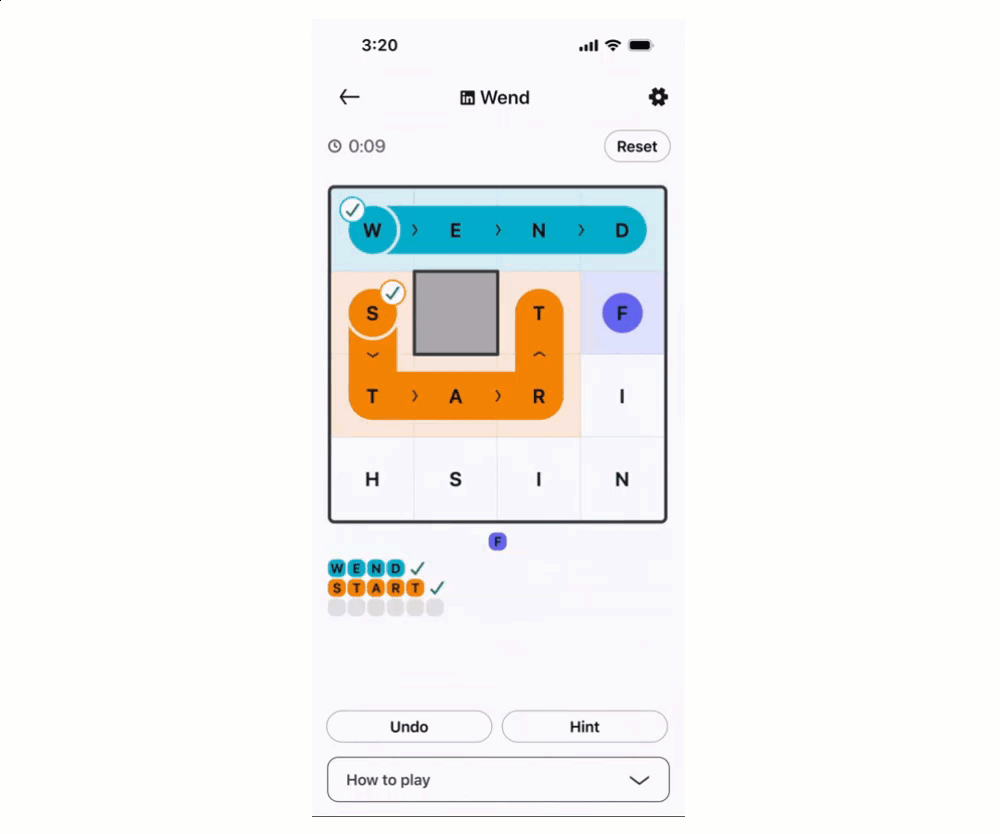
The official tutorial image shows the real game interface and an example puzzle, without revealing today's solution.

LinkedIn Wend official tutorial showing the real game board
Official LinkedIn gameplay tutorial
1

Use the word-length list as a constraint

Before tracing anything, read the required lengths beneath the grid. If the puzzle needs words of five, six, seven, and eight letters, a visible four-letter word cannot be an answer by itself. It may be the beginning or end of a longer route. The length list prevents wasted submissions and helps you decide whether a promising letter chain needs to continue around a corner.

After finding one word, cross off its length mentally and reassess the rest. Duplicate lengths mean multiple answers may compete for similar paths, while a single long slot can explain a distinctive chain around an edge. Treat word length like a structural clue rather than a final check. It narrows the vocabulary search before you commit any cells.
2

Begin with constrained letters

Corners have only two neighbours and edge cells have three, so they are natural starting points. Rare letters and unusual consonant pairs also limit possibilities. Ask whether the constrained letter is more likely to begin, end, or sit inside a word of one of the required lengths. Working outward from difficult cells reduces the chance of leaving an impossible fragment after easier central words are removed.

Do not assume every route reads in the direction your eye first follows. A word can turn repeatedly and may be easier to spot backward from a suffix. Look for familiar beginnings and endings—common prefixes, plural endings, and letter clusters—then trace both directions through orthogonally adjacent cells. Wend’s name hints at the winding paths, but every turn still has to spell continuously.

3

Evaluate the leftover board before submitting

A candidate word should pass two tests: it is valid, and its removal leaves connected paths of the required sizes. Before releasing a drag, inspect the cells it would surround or separate. If three letters become isolated while the shortest remaining slot is five, the candidate cannot be part of the final partition even if the word itself is accepted by a dictionary.

Count connected components after long words. The remaining letters do not all need to stay in one group, because separate words may occupy separate areas, but each group must be divisible into the lengths still required. A six-cell island is useful when a six-letter answer remains and fatal when only two five-letter words remain. This simple accounting turns guessing into logic.

4

Use partial words without overcommitting

Sometimes you can see a promising stem but not its complete path. Record it mentally and test nearby endings rather than dragging the first full word you notice elsewhere. Multiple candidate paths for the same word may use different cells; one route can preserve a corner while another blocks it. The correct spelling is only half the choice—the geometry of the trace matters too.

Correct submitted words remain highlighted and fill a matching row. An incorrect word may remain highlighted on the grid without completing a row, which is useful feedback but not confirmation. If the board stalls, use Undo to remove the most structurally expensive word first: usually the long central path or the choice that created a small isolated pocket.

5

Manage hints, backtracks, and the timer

LinkedIn provides Hint, Undo, and Reset. A hint can erase mistakes or reveal the next correct letter in sequence. The shared Wend score may show completion time, number of backtracks, and no-hint or no-backtrack labels. Because the puzzle mixes discovery and routing, one careful pause before the first trace can save several later reversals.

New Wend puzzles arrive at midnight Pacific Time and old boards expire. Improve by reviewing the shape of a difficult solve after completion: which corner was constrained, which word length provided the breakthrough, and which attractive false word stranded letters? These observations transfer to future boards far better than memorizing a daily answer. Speed follows from a larger vocabulary of path patterns and more consistent leftover checks.

Common mistakes to avoid

These are rule misunderstandings and decision habits that create most avoidable errors.

Connecting diagonally

Wend paths move only up, down, left, or right. A diagonal letter may look close but is not adjacent under the official rules.

Accepting any valid word

The answer must also match an open length slot and leave every unused letter available for the remaining words.

Starting in the open centre

Central cells offer many options. Corners, edges, rare letters, and unusual clusters usually provide stronger first constraints.

Ignoring leftover components

A chosen path can strand too few letters to satisfy any remaining word length, forcing a later backtrack.

Wend FAQ

Quick answers about rules, access, reset time, and score sharing.

Can Wend words use diagonal letters?

No. LinkedIn’s official Wend rules allow horizontal and vertical adjacency only. A word may turn, but every consecutive letter must share an edge.

Does every letter have to be used in Wend?

Yes. Each letter is used exactly once across the complete set of hidden words, and accepted words cannot overlap.

What do the empty rows below the Wend grid mean?

They show how many hidden words the puzzle contains and how many letters belong in each word, providing an important constraint before you trace.

What appears in a shared Wend result?

LinkedIn may show solve time, backtrack count, and labels indicating that no hints or no backtracks were used.

When was LinkedIn Wend released?

Wend launched in June 2026 as the eighth LinkedIn Game and the first new word game added after the original lineup debuted.

Ready to play Wend?

Rules are checked against LinkedIn Help, and this guide never publishes today's clues, grid, path, or answer.

Spoiler-free by design