LinkedIn Mini Sudoku

A bite-sized 6×6 take on classic Sudoku.

3–8 minutesBy LinkedIn
linkedin.com/games/mini-sudoku
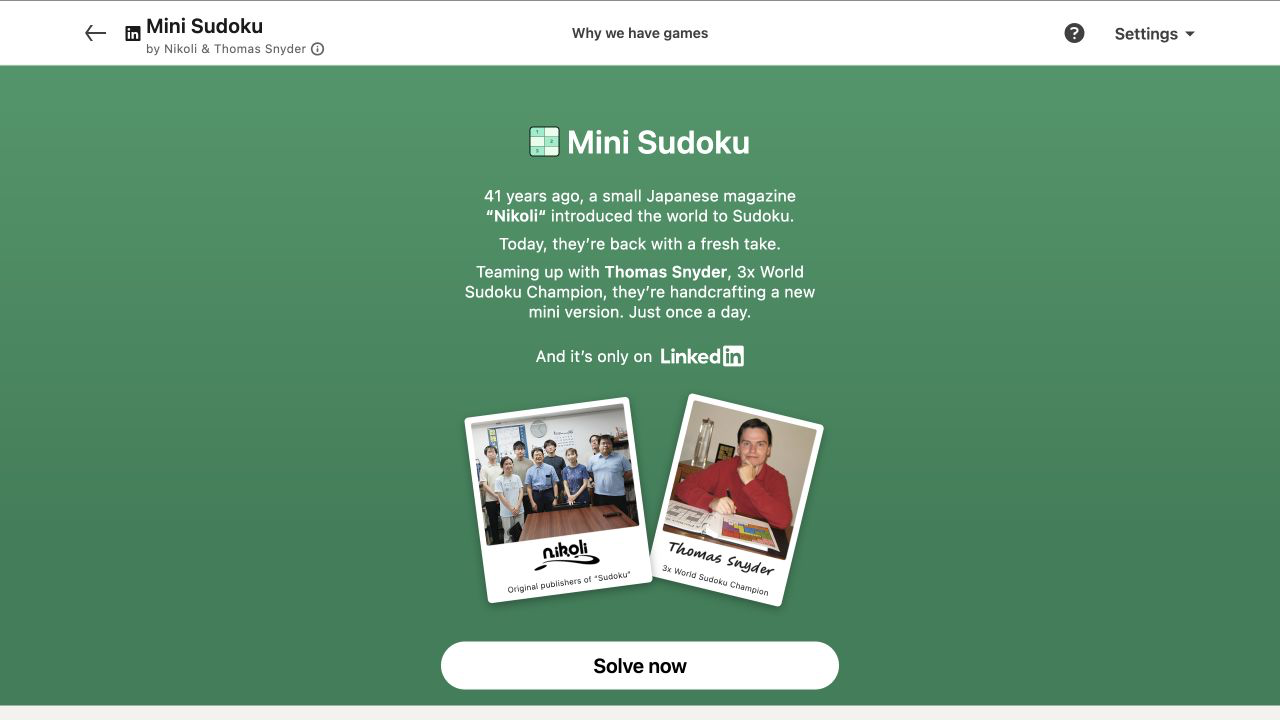
LinkedIn Mini Sudoku official start screen
Official LinkedIn Games start screen, captured August 2026.

What is Mini Sudoku?

Platform
Web
Access
Official LinkedIn link
Schedule
Daily at midnight PT
Session
3–8 minutes

Mini Sudoku is a compact 6×6 Sudoku: fill the grid so every row, column and box contains each digit exactly once. All the deduction of Sudoku in a quick daily format from LinkedIn.

LinkedIn Mini Sudoku compresses classic Sudoku into a 6×6 daily grid. Fill the empty cells with the digits 1 through 6 so every row, every column, and every outlined region contains each digit exactly once. The smaller format is designed for a short session, but the logic remains authentic: no arithmetic is required, and every placement follows from eliminating candidates based on the three intersecting units.

The game was developed with Nikoli—the Japanese publisher that named and popularized Sudoku—and three-time World Sudoku Champion Thomas Snyder. LinkedIn describes each board as handcrafted rather than randomly generated. A useful Mini Sudoku strategy therefore emphasizes clean scanning, candidate discipline, and recognition of interactions between rows, columns, and regions. This guide covers those methods without revealing the current daily grid or solution.

Core rules

  1. 1Fill the 6×6 grid with the numbers 1 through 6.
  2. 2Use each number once in every row and column.
  3. 3Use each number once inside every outlined box.

Mini Sudoku strategy guide

Apply classic Sudoku candidates and scanning to a handcrafted 6×6 grid designed for a focused daily solve.

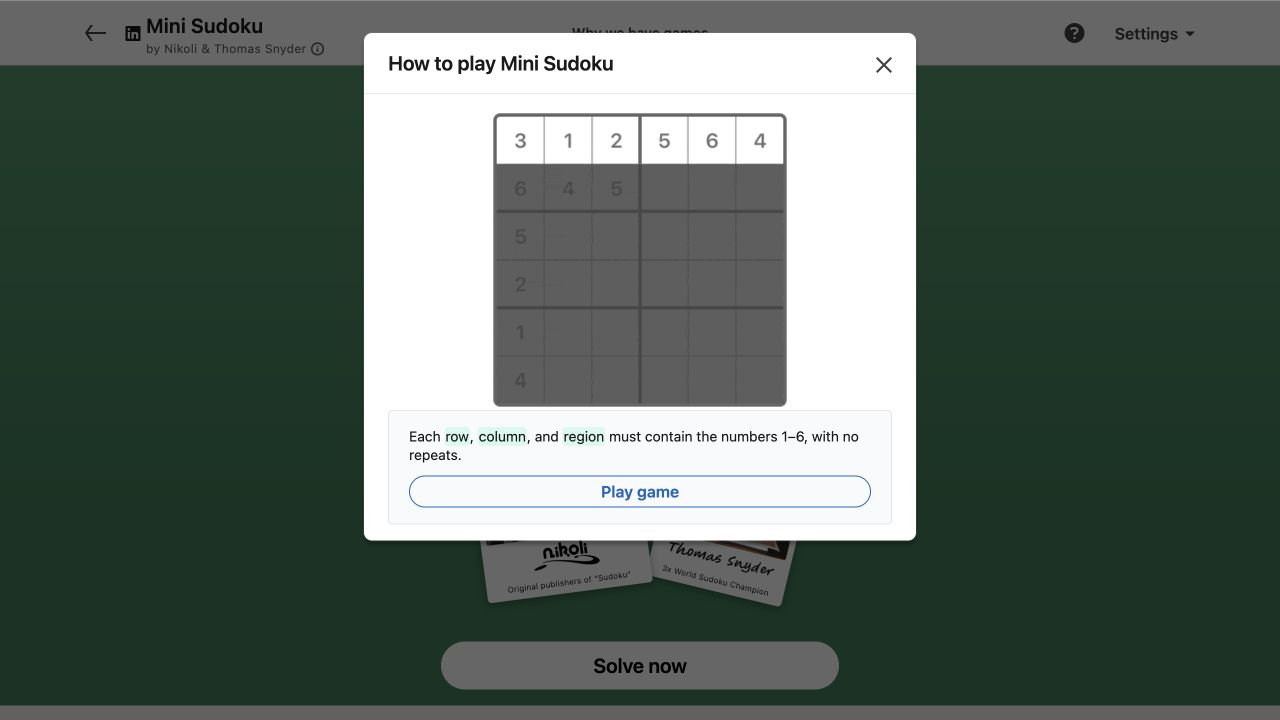
The official tutorial image shows the real game interface and an example puzzle, without revealing today's solution.

LinkedIn Mini Sudoku official tutorial showing the real game board
Official LinkedIn gameplay tutorial
1

Scan by digit before scanning by cell

Choose one number, such as 4, and look for where it already appears. In each region missing that number, eliminate rows and columns that already contain a 4. Often only one cell remains. Repeat for digits 1 through 6. This crosshatching method finds placements that are easy to miss when you inspect empty cells one at a time.

Because the grid is compact, a placed number influences a large fraction of the board. After filling a digit in one region, immediately rescan the same digit across neighbouring regions. A single placement may remove the last candidate from another row or column. Digit-focused passes create natural chains and reduce the need to write many notes early.
2

Separate naked singles from hidden singles

A naked single is a cell with only one possible number after checking its row, column, and region. A hidden single is different: several numbers may fit the cell, but one particular digit has no other available location within that unit. Both are forced placements. Learning to search for hidden singles is the biggest step from casual filling to consistent Mini Sudoku solving.

When a line is nearly complete, list its missing numbers and test each empty cell against the crossing column and region. Do not rely on visual intuition alone; articulate why every other candidate is excluded. On a 6×6 board the candidate set is small enough to do mentally, but LinkedIn also provides a notes feature when several cells remain unresolved.

3

Use pairs to remove candidates

If two cells in the same row, column, or region can contain only the same two numbers, those values are locked into that pair. Other cells in the unit cannot use either number. The pair does not tell you the order yet, but its elimination effect may create a single elsewhere. This is often the bridge between straightforward opening placements and the final section of a harder board.

A related pattern occurs when all candidates for one digit within a region lie in a single row or column. That digit is locked to the line inside the region, so it can be removed from the rest of that line outside the region. These interactions are easier to see in Mini Sudoku than in a 9×9 grid and make excellent practice for full-size puzzles.

4

Keep notes useful and temporary

Candidate notes should reduce uncertainty, not cover every cell with six tiny numbers. Begin by scanning for direct placements. Add notes only when a cluster genuinely has several possibilities, and erase candidates after every confirmed number. Stale notes are a common source of mistakes because they preserve values that a later placement has already ruled out.

LinkedIn also offers hints, Auto-check, highlighting, Undo, and other familiar Sudoku assistance. If Auto-check reports a problem, undo the unsupported placement and reconstruct its candidates. Guessing one of two numbers may produce a fast time when lucky, but it teaches less and can create a chain of internally consistent-looking errors on the unlucky branch.

5

Build speed from scan order

Use a stable loop: scan each digit across regions, finish rows or columns with few blanks, inspect hidden singles, then look for pairs. After every placement, return briefly to the affected row, column, and region. This is faster than restarting a random whole-board search and makes it less likely that a simple consequence remains unnoticed.

LinkedIn’s shared Mini Sudoku result can show solve time and whether mistakes or hints were used. The game is intended to fit in roughly a few minutes, but difficulty can increase through the week. Compare accuracy and reliance on notes before comparing raw speed. A new handcrafted puzzle appears at midnight Pacific Time, and the previous daily board expires.

If a late-week puzzle feels noticeably tougher, keep the same sequence instead of inventing a shortcut. Easy boards may finish through direct singles, while harder ones make better use of pairs and locked candidates. The technique changes in depth, not in principle. That consistency is one reason the six-number format works well as daily Sudoku practice: the feedback loop is short enough to notice exactly which deduction opened the grid.

Common mistakes to avoid

These are rule misunderstandings and decision habits that create most avoidable errors.

Doing arithmetic

Sudoku numbers are symbols, not quantities. A placement is determined by uniqueness in its row, column, and region.

Checking only two units

A candidate must be legal in all three places at once: its row, its column, and its outlined region.

Guessing a two-candidate cell

Look for hidden singles, locked candidates, or pairs elsewhere before choosing between two unsupported values.

Leaving stale notes

Candidate marks must be updated after every placement or they will hide new singles and suggest invalid numbers.

Mini Sudoku FAQ

Quick answers about rules, access, reset time, and score sharing.

What size is LinkedIn Mini Sudoku?

The daily puzzle uses a compact 6×6 grid with digits 1 through 6. Every row, column, and outlined region must contain each digit once.

Who makes LinkedIn Mini Sudoku?

LinkedIn introduced the game with Nikoli, the publisher associated with Sudoku’s name and popular form, and three-time World Sudoku Champion Thomas Snyder.

Does Mini Sudoku require math?

No. The digits could be replaced with six symbols. Solving depends on logical elimination and uniqueness, not addition, multiplication, or numerical calculation.

Can I use candidate notes?

Yes. LinkedIn includes a notes feature along with hints, checking, highlighting, and undo tools. Notes are most useful after direct singles have been exhausted.

What does the Mini Sudoku score show?

LinkedIn says the shared score includes completion time and may identify a solve with no mistakes, no hints, or both, depending on how you played.

Try another puzzle

Ready to play Mini Sudoku?

Rules are checked against LinkedIn Help, and this guide never publishes today's clues, grid, path, or answer.

Spoiler-free by design